Big Ben facts and figures
Which tour gets you closest?No tour sold on GetYourGuide climbs the Elizabeth Tower — UK Parliament runs that one itself. What you can book here is the building Big Ben belongs to, with a ticket inside the Houses of Parliament, or a guided walk past the tower, the Abbey and Buckingham Palace.
Compare the optionsBell, clock or tower
“Big Ben” is the nickname of the Great Bell. The clock is the Great Clock, and the tower that holds both was officially the Clock Tower until 2012, when it was renamed the Elizabeth Tower for Elizabeth II’s Diamond Jubilee. Parliament dates the House of Commons Commission’s decision to 25 June 2012. Wikipedia spreads the change across an announcement on 2 June, confirmation on 26 June and formal completion on 12 September, so “2012, for the Diamond Jubilee” is the answer nobody disputes. Victorian journalists sometimes called it St Stephen’s Tower.
Nobody is sure where the name Big Ben came from. The two candidates are Sir Benjamin Hall, the Commissioner of Works, and the boxer Ben Caunt. I have heard both told as settled fact on Parliament Square; neither is.
What Londoners call it
Big Ben, for all of it. I grew up in Pimlico, fifteen minutes’ walk from Parliament Square, and at home “Big Ben” meant the tower, the clock and the bongs at once. Parliament’s own history of the tower accepts that people in Britain and around the world call the whole thing Big Ben (how the tower has changed over the decades). I use “the Elizabeth Tower” on this site only where the difference matters, such as which part you climb.
What it is made of
A brick core faced mainly in Anston limestone, a sand-coloured stone from South Yorkshire, with a spire covered in cast-iron roof tiles. Parliament’s Big Ben facts and figures lists 2,600 m³ of brick and 850 m³ of stone, and names Clipsham limestone from Rutland and Caen stone from France alongside Anston. The tower stands on a footprint 12 m square and rises through 11 floors to 96 m, which Parliament describes as 21 London buses stacked. It leans about 230 mm to the north-west. The Victoria Tower at the other end of the Palace is taller, at 98.5 m, which surprises almost everyone I mention it to.
The Great Clock
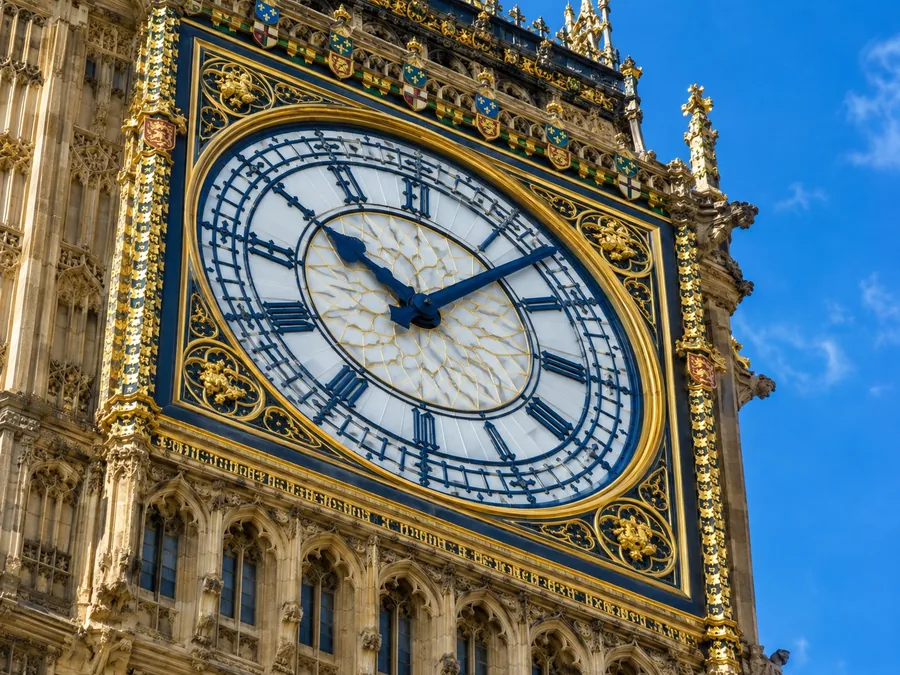
There are four dials, each 6.9 m across and made of 324 pieces of pot opal glass in a cast-iron frame. The hour numerals are 60 cm long. The minute hands are copper, 4.2 m long and 100 kg; the hour hands are gunmetal, 2.7 m and 300 kg. Behind them the mechanism weighs 5 tonnes, and the pendulum is 4.4 m long, weighs 310 kg and beats once every two seconds. Denison’s double three-legged gravity escapement keeps it accurate, and the clock has run since 31 May 1859.
It is still fine-tuned with old pre-decimal pennies laid on the pendulum. Each penny added makes the clock gain 0.4 seconds a day. On Parliament’s tour you stand in the Mechanism Room and behind one of the dials, which is the closest anyone gets to the pennies; how that tour works is on going inside Big Ben.
The bells and the crack
Big Ben weighs 13.7 tonnes and is struck by a 200 kg hammer. Four quarter bells, of 1.1, 1.3, 1.7 and 4 tonnes, play the Westminster Quarters. None of them swings: the bells hang fixed and hammers strike them.
The bell you hear is the second attempt. The first, cast in 1856 at Warners in Stockton-on-Tees, cracked in testing in 1857. The second was cast in 1858 at the Whitechapel Bell Foundry and hauled by 16 white horses. It first struck on 11 July 1859 and cracked the same year. In 1863 it was turned 90° and given a lighter hammer, and it has struck ever since. The crack was never repaired.
Five facts I tell visitors
- Each minute hand travels about 190 km a year, roughly the distance from London to Weymouth.
- In 1949 a flock of starlings perched on a minute hand and slowed the clock by 4.5 minutes.
- The dials were black for about 90 years, only to hide pollution. The original 1859 colour, restored in 2022, is Prussian blue; the story is on Big Ben’s history.
- In 1930 an MP complained that Big Ben was 3 minutes slow. The minister replied that all the other clocks were wrong.
- Between the first chimes and 2026 there have been six monarchs and 41 prime ministers.
Who owns Big Ben
The Crown. The Palace of Westminster belongs to the King in right of the Crown and is controlled by the two Houses of Parliament; the Elizabeth Tower is part of the Palace and is managed by the House of Commons. The Palace has been Grade I listed since 1970 and, together with Westminster Abbey and St Margaret’s Church, a UNESCO World Heritage Site since 1987.
Not part of Buckingham Palace
I have been asked this on Parliament Square more than once, by people holding a map. Big Ben belongs to the Palace of Westminster, the Houses of Parliament. Buckingham Palace is the monarch’s London residence, about 1 mile away, 15 to 20 minutes on foot through St James’s Park. The mix-up is understandable, because Westminster is technically still a royal palace owned by the Crown. What else is in walking distance is on what is near Big Ben.
Seeing it with a guide
No tour sold on GetYourGuide goes up the tower; UK Parliament sells that climb itself. The most booked walk past it starts at the Churchill statue in Parliament Square and spends about 15 minutes at Big Ben before the Abbey, St James’s Park and Buckingham Palace, 3.2 km in all, with a Blue Badge guide and at most 20 people. Big Ben and the palace are seen from outside only. The 4-hour option adds a guided visit inside Westminster Abbey. It rates 4.8 from 3,969 reviews, and Kimball’s group ran to “ages from 10-70”. Cancel up to 24 hours ahead for a full refund.
Frequently asked questions
What are 5 interesting facts about Big Ben?
The clock is fine-tuned with old pre-decimal pennies, each adding 0.4 seconds a day. The bell has been cracked since 1859 and was turned 90° in 1863 rather than recast. Each minute hand travels about 190 km a year. The dials were black for about 90 years to hide pollution. In 1949 starlings on a minute hand slowed the clock by 4.5 minutes.
Is Big Ben the same as the Elizabeth Tower?
Not strictly. Big Ben is the 13.7-tonne Great Bell; the Elizabeth Tower is the 96 m tower it hangs in. In everyday speech, in Britain and abroad, Big Ben means the whole tower. The 334 steps up it are described on climbing Big Ben.
What do Brits call Big Ben?
Big Ben. Londoners use it for the tower, the clock and the bell alike, and Parliament’s own history pages accept that usage. The official name of the tower, the Elizabeth Tower, turns up mostly where precision matters.
When did Big Ben get renamed?
The bell was never renamed. The tower, formerly the Clock Tower, became the Elizabeth Tower in 2012 for Elizabeth II’s Diamond Jubilee. Parliament dates the decision to 25 June 2012; other accounts run from an announcement on 2 June to formal completion on 12 September.
What is Big Ben made of?
The tower is a brick core faced mainly in Anston limestone from South Yorkshire, with some Clipsham and Caen stone, and its spire is covered in cast-iron roof tiles. The clock dials are cast-iron frames holding 324 pieces of pot opal glass each.
Who owns Big Ben?
The Crown. The Palace of Westminster is owned by the King in right of the Crown and controlled by the two Houses of Parliament, and the House of Commons manages the Elizabeth Tower.
Is Big Ben part of Buckingham Palace?
No. Big Ben is part of the Palace of Westminster, the Houses of Parliament. Buckingham Palace is about 1 mile away, 15 to 20 minutes on foot through St James’s Park.